
Artificial intelligence is no longer just a buzzword; it’s a real force shaping how we live, work, and interact with technology. From recommending what you should watch next on Netflix to assisting doctors in early disease detection, AI is everywhere. At the heart of this transformation lies deep machine learning, one of the most powerful tools in modern computing.
But what exactly does “deep machine learning” mean? In simple terms, it’s a specialized approach within machine learning that relies on multi-layered neural networks to process massive amounts of data.
Unlike traditional algorithms, which often depend on manual input and feature selection, deep machine learning can automatically discover patterns and insights directly from raw data. This is why it powers breakthroughs in natural language processing, image recognition, voice assistants, and predictive analytics.
In this guide, we’ll break down the concept of deep machine learning, explain how it works step by step, highlight the tools you’ll need, discuss its challenges, and give you a practical roadmap if you’re just starting out.
What is Machine Learning
Before diving into deep machine learning, it’s important to understand the foundation: machine learning (ML).
Machine learning is a branch of artificial intelligence that enables computers to learn from data rather than relying on explicit instructions. Instead of programming every rule, we provide the machine with examples and algorithms, and it gradually improves its performance by recognizing patterns.
There are three main types of machine learning:
- Supervised Learning: The model is trained with labeled data. For example, you show it hundreds of images of cats and dogs, and it learns to classify new ones correctly.
- Unsupervised Learning: The system works with unlabeled data to find patterns or groupings. An example would be clustering customers by buying habits without knowing anything about them beforehand.
- Reinforcement Learning: The model learns by interacting with its environment. It makes decisions, receives feedback in the form of rewards or penalties, and adjusts its actions over time.
If you’re looking for a simple way to picture it, think of ML as teaching by example. Just like a child learns to distinguish between fruits by seeing enough apples and oranges, machines learn by analyzing large amounts of data.
Tools such as Scikit-learn, TensorFlow, and AWS SageMaker make building and experimenting with ML models accessible even to beginners.
Deep machine learning powers many modern AI tools. If you want to see real world examples of this technology in action, check out our guide on the best AI personal assistants in 2026. It explains which tools are leading the market and how they use advanced learning systems to understand and respond better.
What is Deep Learning
Deep learning is a branch of machine learning that takes inspiration from how the human brain works. It uses neural networks with many layers, often called deep neural networks, to process data and uncover patterns that simpler models can’t handle.
What makes deep learning different is its ability to learn features automatically. In traditional machine learning, data scientists often need to spend time extracting and engineering features manually. With deep learning, the system can take raw data—like images, audio, or text—and figure out the important features on its own.
Some everyday applications of deep learning include:
- Image recognition: Powering tools like Google Photos or facial recognition in smartphones.
- Natural language processing (NLP): Enabling chatbots, virtual assistants, and translation apps.
- Autonomous vehicles: Helping self-driving cars detect objects and make decisions.
- Healthcare diagnostics: Assisting doctors by analyzing medical images and predicting outcomes.
This is why so many people search for terms like what is deep learning AI-because it explains how machines can move beyond basic predictions and actually understand complex data.
What is Deep Machine Learning
Now that the difference between machine learning and deep learning is clear, let’s focus on deep machine learning.
Deep machine learning refers to using multi-layered neural networks to solve highly complex problems that require advanced abstraction. Think of it as the practical application of deep learning within broader AI systems.
Here are some real-world examples where deep machine learning is applied:
- AI assistants like Siri, Alexa, or Google Assistant that understand human language.
- Recommendation engines on platforms such as YouTube, Netflix, or Amazon.
- Financial forecasting tools that predict stock movements or detect fraud.
- Medical research applications that analyze genetic data or identify disease markers.
Frameworks like TensorFlow, PyTorch, and Keras make it possible to design, train, and deploy these deep learning models. When people search for what deep machine learning is, they’re usually trying to understand how today’s most advanced AI systems-from voice recognition to predictive analytics—are built.
How Does Deep Machine Learning Work
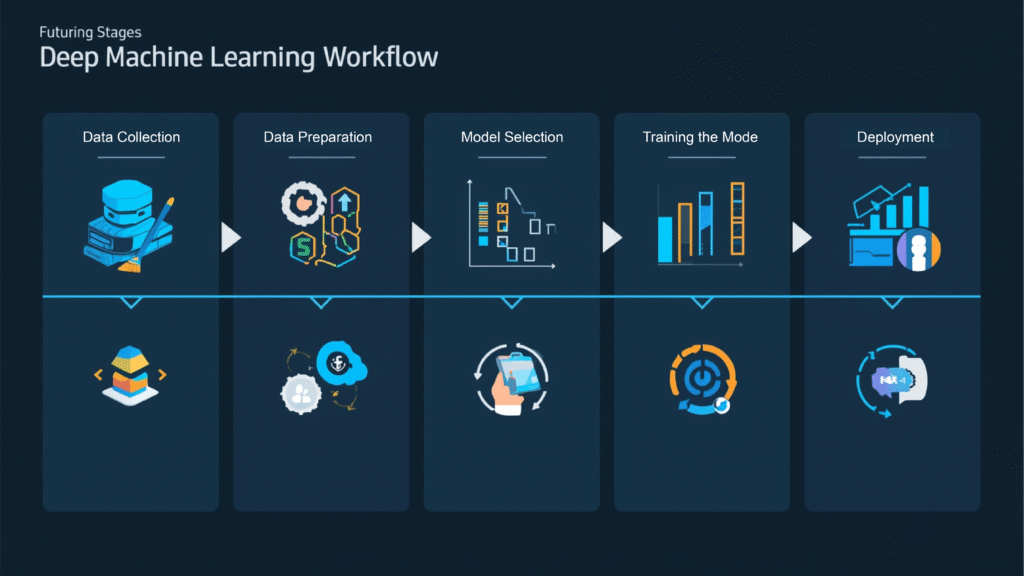
Deep machine learning allows computers to learn from vast amounts of data and uncover patterns too complex for traditional programming. Instead of relying on fixed rules, the system adapts and improves its predictions by examining examples over time.
Building an effective deep learning model involves several essential stages, each contributing to the model’s ability to perform reliably in real-world tasks.
1. Data Collection
A model’s accuracy depends on the quality and size of its dataset. The more diverse the data, the better the model can understand different scenarios. Common sources of data include:
- Open datasets such as MNIST, CIFAR-10, and ImageNet, which provide labeled images for research and training.
- Company or organizational databases, containing structured or unstructured internal data.
- APIs and web scraping allow for real-time or large-scale collection of relevant information.
- Sensor readings from IoT devices, capturing environmental or behavioral data.
Raw data is rarely perfect. Missing values, duplicates, or irrelevant entries can mislead the model, causing inaccurate predictions. Collecting clean, representative data ensures the model learns meaningful patterns. This stage directly addresses queries like “what is machine learning in simple words” and “how does machine learning work.”
2. Data Preparation
Once data is collected, it must be processed before being fed into a neural network. Proper preparation ensures the model can learn efficiently and generalize to new situations. Important steps include:
- Cleaning: Fix errors, remove duplicates, and handle missing information.
- Normalization and Scaling: Adjust numeric values to a consistent range so the network can train faster and more reliably.
- Feature Engineering: Identify or construct key features that highlight the most important aspects of the data.
- Data Augmentation: Expand datasets artificially, such as rotating, flipping, or changing colors of images, to improve model performance on varied inputs.
This stage prevents the model from memorizing the training examples and ensures it performs well on unseen data. Beginners often explore this phase when searching for “what is machine learning and deep learning.”
3. Model Selection
Choosing the right type of neural network is one of the most critical decisions in deep machine learning. Each model architecture is designed for specific data types and tasks:
- Convolutional Neural Networks (CNNs): Best suited for image recognition, object detection, and video analysis.
- Recurrent Neural Networks (RNNs): Used for time-series data, speech recognition, and natural language tasks.
- Generative Adversarial Networks (GANs): Powerful for creating realistic images, videos, or even synthetic data.
- Transformers: Currently the most advanced for natural language processing, powering models like BERT and GPT.
The architecture you choose should match your problem. For example, a CNN is effective for medical image classification, while a Transformer is ideal for building a chatbot. This stage naturally connects with searches like “what is deep learning in AI” or “TensorFlow, what is.”
4. Training the Model
Training is where the deep learning system begins to “understand” data. It uses labeled datasets to minimize errors and gradually improve predictions. The process involves:
- Forward Propagation: Input data passes through the network’s layers to generate predictions.
- Loss Function: Calculates the difference between predicted outputs and actual values.
- Backpropagation: Adjusts the model’s weights based on error signals to improve accuracy.
- Optimization Algorithms: Methods like Stochastic Gradient Descent (SGD) or Adam Optimizer help find the most efficient solution.
Training is often done on GPUs or TPUs because of the heavy computation. The aim is to reduce errors with every iteration, answering user queries like “how does deep learning work” and “what is supervised machine learning.”
5. Evaluation
After training, the model must be tested on unseen data to measure real performance. Key evaluation techniques include:
- Metrics: Precision, recall, F1-score, accuracy, and ROC-AUC are common benchmarks.
- Overfitting Check: Comparing training results with validation data to ensure the model hasn’t just memorized patterns.
- Error Analysis: Studying mistakes to identify weaknesses, which may point to issues in data quality or architecture.
Evaluation ensures that the model is both accurate and reliable, and it is a critical step before deploying solutions to users. This phase is linked to searches like “what is machine learning definition” and “what does machine learning mean.”
6. Deployment
Once the model proves effective, it can be integrated into real-world applications. Deployment allows businesses and developers to generate value from the trained system. Examples include:
- AI Assistants: Voice or chat-based assistants that understand human language.
- Recommendation Engines: Personalized product, movie, or content suggestions.
- Predictive Analytics: Forecasting customer behavior, sales trends, or financial risks.
- Computer Vision Systems: Facial recognition, quality inspection, or autonomous driving.
Deployment can be achieved on cloud platforms like AWS SageMaker, Azure Machine Learning, or on-premise systems and edge devices. This step naturally fits keywords such as “what is AWS SageMaker” and “what is online machine learning.”
Tools and Frameworks for Deep Machine Learning

Working with deep machine learning is much easier when you use the right tools. These frameworks and platforms help you build, train, and deploy models without getting lost in complex code.
TensorFlow is one of the most popular choices. It lets you create neural networks of different sizes and experiment with different designs. Beginners often search “TensorFlow what is” because it’s beginner-friendly and flexible enough for real projects.
PyTorch is another widely used framework, especially in research. It allows you to see how data moves through the network step by step, which is great for experimenting and understanding model behavior.
Keras makes building neural networks simpler. It works well with TensorFlow and lets you focus on designing the model rather than worrying about coding every detail.
Scikit Learn is mostly used for traditional machine learning tasks, like preprocessing data, testing models, and measuring performance. Searches like “scikit learn what is” or “what is scikit learn in Python” are common when beginners want to know how it works with deep learning projects.
For large-scale model training, AWS SageMaker provides a cloud environment that handles computation and deployment efficiently. And if you’re experimenting, Google Colab and Jupyter Notebooks allow interactive coding and visualization without heavy setup.
Advanced users also use XGBoost for boosting models, TensorBoard to visualize training progress, and MLflow to track experiments. Combining these tools makes deep learning projects much more manageable and productive.
Types of Deep Machine Learning
Deep learning can take several forms depending on the task and the data available. Knowing the type helps you choose the right approach.
Supervised Deep Learning uses labeled data. The model knows the correct answer for each input. This method is used in image recognition, spam detection, and other classification problems.
Unsupervised Deep Learning works with unlabeled data. The model looks for patterns and groupings by itself. Recommendation systems often use this approach to suggest items based on user behavior.
Reinforcement Learning teaches the model through trial and error. The system gets rewards for correct actions and penalties for mistakes. It’s commonly used in robotics, games, and self-driving car simulations.
Federated Learning trains models across multiple devices without moving the data. This protects privacy and is helpful when sensitive information cannot leave a user’s device.
Transfer Learning lets you take a model trained on one task and adapt it for a different task. This is especially useful when your dataset is small or when training from scratch would take too long.
Each of these types has its own use cases, and understanding them helps answer questions like “what is supervised learning” or “what is federated learning.”
Challenges of Deep Machine Learning
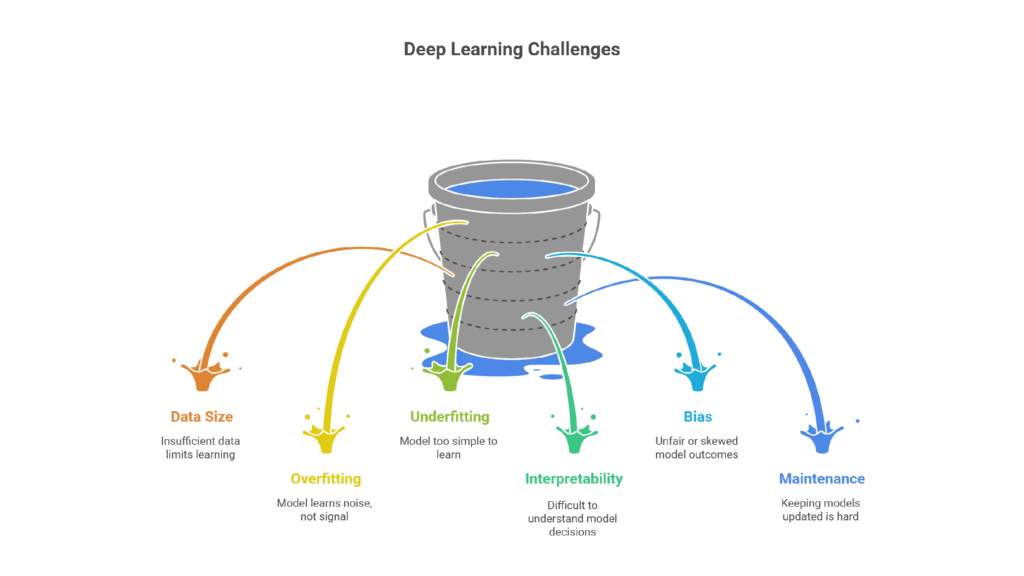
Even though deep learning is powerful, it comes with challenges that can’t be ignored.
One major challenge is data. Large amounts of high-quality data are needed for training. Small datasets often lead to weak models, while very large datasets require strong hardware.
Training models also demands computing power. GPUs or TPUs speed up learning, but they can be expensive.
Models can overfit, meaning they memorize the training data instead of learning patterns. They can also underfit, when the network is too simple to capture important patterns. Both issues reduce the model’s accuracy on new data.
Interpretability is another hurdle. Neural networks often act like black boxes, making it hard to understand why a model made a particular decision. Bias in data can lead to unfair outcomes, especially in sensitive fields like finance or healthcare.
Finally, models must be maintained and updated. A model that worked last year may fail today if new data trends are not considered. Knowing these challenges helps build more reliable and fair deep learning systems.
How to Start Learning Deep Machine Learning
Starting in deep machine learning can seem overwhelming, but breaking it down into small steps makes it easier. Here’s a practical approach:
- Learn the Basics of AI and Machine Learning
Begin by understanding what is machine learning, what is deep learning, and how artificial intelligence works. Learn the differences between supervised, unsupervised, and reinforcement learning. Many beginners search “what is AI and machine learning” or “what is machine learning in simple words” at this stage. - Learn Python Programming
Python is the most common language for deep learning. Libraries like TensorFlow, PyTorch, and Scikit Learn depend on it. Focus on basics such as loops, data structures, and functions, and also explore NumPy, pandas, and Matplotlib for data handling and visualization. - Work on Hands-On Projects
Practice is essential. Start with small datasets like MNIST, CIFAR-10, or text datasets. Try building simple models first, then gradually increase complexity. This answers beginner searches like “how to start machine learning from scratch” and “what is machine learning with an example.” - Learn Deep Learning Frameworks
Explore TensorFlow, PyTorch, and Keras. Learn how to build neural networks, train them, and test performance. Cloud platforms like AWS SageMaker can help scale your experiments. - Take Structured Courses
Online courses from Coursera, IBM, or AWS provide guided projects and practical exercises. They help you move from theory to hands-on practice. - Experiment and Iterate
Train models, evaluate errors, adjust parameters, and try different architectures. Iteration is key to improving model performance and understanding. - Join Communities
Participate in Kaggle competitions, online forums, or GitHub projects. Sharing your work and learning from others accelerates progress and helps solve problems faster.
Following these steps addresses common queries like “how do I learn machine learning” and “how can I learn machine learning”, giving beginners a structured learning path.
Conclusion
Deep machine learning is a critical part of modern AI. By understanding what is deep machine learning, how it works, the tools needed, its types, and the challenges, you can begin building advanced AI systems.
Starting with small projects, learning Python, and exploring frameworks like TensorFlow, PyTorch, or AWS SageMaker gives a solid foundation. Deep machine learning powers applications such as AI assistants, recommendation systems, predictive analytics, and computer vision.
With consistent practice and hands-on experimentation, even beginners can gain the skills to create intelligent systems. Each step you take today builds the foundation for more complex AI solutions in the future.
Frequently Asked Questions (FAQs)
What is the difference between machine learning and deep machine learning?
Machine learning covers algorithms that learn from data. Deep machine learning uses multi-layered neural networks for complex tasks that require high-level abstraction.
Do I need coding skills for deep machine learning?
Yes. Python is essential for working with frameworks like TensorFlow, PyTorch, and Keras.
Can deep machine learning work with small datasets?
It usually works best with large datasets. Transfer learning and data augmentation can help when data is limited.
What is the role of TensorFlow in deep machine learning?
TensorFlow helps design, train, and deploy neural networks efficiently, making it easier to work with different architectures.
What hardware is needed for deep machine learning?
High-performance GPUs or TPUs are recommended for training large models. Smaller experiments can run on standard CPUs or cloud platforms.