
If you’ve spent any time researching schools in Dubai, you’ve run into the letters “KHDA” within the first five minutes. Every school website has a badge.
Every parent WhatsApp group has an opinion. Every school tour ends with someone asking, “but what’s their KHDA rating?”
The rating matters. But most parents are only getting the headline number, not what’s actually behind it, and 2026 is a genuinely different year for KHDA ratings than the past two years were.
Here’s the full picture: what the rating means, how it’s built, what changed recently, and how to actually use it when you’re choosing between schools.
What KHDA Is, and Who’s Actually Doing the Inspecting
KHDA is the Knowledge and Human Development Authority, Dubai’s government regulator for private education. It oversees schools, universities, and nurseries across the emirate.
The actual inspection work is done by a division called DSIB, the Dubai Schools Inspection Bureau. DSIB sends trained inspection teams into private schools, and those teams produce the public reports and ratings that end up on KHDA’s website and, eventually, on every school’s marketing page.
Dubai’s private school sector is large. It serves roughly 387,000 students from around 185 nationalities, spread across more than 220 schools offering some 17 different curricula, everything from UK and US curricula to IB, Indian, French, and others.
That diversity is part of why KHDA inspections dig into more than just exam scores. A one-size-fits-all measure of “good” doesn’t work across that many curricula and student populations, so the framework is built around broad standards that apply regardless of curriculum.
Something Changed: Inspections Were Paused, and 2026-27 Brings a New Model
This is the part most existing blog posts online haven’t caught up with yet, and it’s important if you’re researching schools right now.
KHDA paused its regular inspection cycle for two consecutive academic years, 2024-25 and 2025-26. During that pause, schools weren’t sitting completely unmonitored.
Newly established schools completing their third year of operation still received inspections, and KHDA kept an eye on things through school self-evaluation reports and performance data analysis. But the full inspection cycle that used to run every year or two simply stopped for most schools.

That changes starting in the 2026-27 academic year. KHDA is resuming quality assurance visits, but under a meaningfully different model than before. Here’s what’s new:
Two types of visits, not one. Schools will now receive either a full inspection or a shorter monitoring visit. A full inspection is the comprehensive version, done by specialist teams working through the complete UAE School Inspection Framework, and it results in a published overall rating.
A monitoring visit is narrower. It’s based on specific areas KHDA’s data analysis flags as worth checking, and it produces a report with strengths and recommendations, but it does not generate a new overall published rating.
Which visit a school gets isn’t random or fixed on a schedule. KHDA is using a data-driven approach, looking at each school’s performance history, self-evaluation reports, and other indicators to decide which type of visit fits.
One exception: any school completing its third year of operation in Dubai automatically gets a full inspection. Brand new schools in their first or second year aren’t inspected at all yet.
Notice periods just got a lot shorter. Schools used to get about five working days’ notice before an inspection. Now it’s a maximum of 24 hours. The stated reason is to see schools as they actually run day to day, not a version polished specifically for inspection week. For parents, this arguably makes the resulting ratings more trustworthy, since there’s less room for a school to stage its best possible version of itself.
The focus this cycle is on improvement, not just a fresh snapshot. Because two years passed without full inspections, KHDA has said this round will look closely at what schools did with that gap. Did they act on the last known issues? Did they use the pause productively? That context matters if you’re comparing a school’s current rating to one it had from a few years ago, since the current rating reflects a longer improvement window than usual.
Practically, what this means for you as a parent: if a school’s KHDA rating on its website is from 2023-24, that’s likely still the most recent official rating available, and it may stay that way until that specific school goes through a 2026-27 inspection or monitoring visit. Always check the inspection date next to the rating, not just the rating itself.
The Six-Point Rating Scale
KHDA rates schools on a six-point scale, part of the UAE Unified Inspection Framework that Dubai, Abu Dhabi, and Sharjah all now share. That’s worth knowing if you’re comparing a Dubai school to one in Abu Dhabi (rated by ADEK) or Sharjah (rated by SPEA), since the scale and standards are designed to line up.
| Rating | What it signals |
| Outstanding | Performance substantially exceeds UAE expectations across almost every area |
| Very Good | Performance clearly exceeds expectations, with only minor gaps |
| Good | Performance meets expectations. This is the baseline every Dubai school is expected to hit |
| Acceptable | Meets the minimum required level, but with clear areas needing improvement |
| Weak | Falls below the minimum required level |
| Very Weak | Falls significantly below the minimum, with serious concerns, potentially including student welfare |
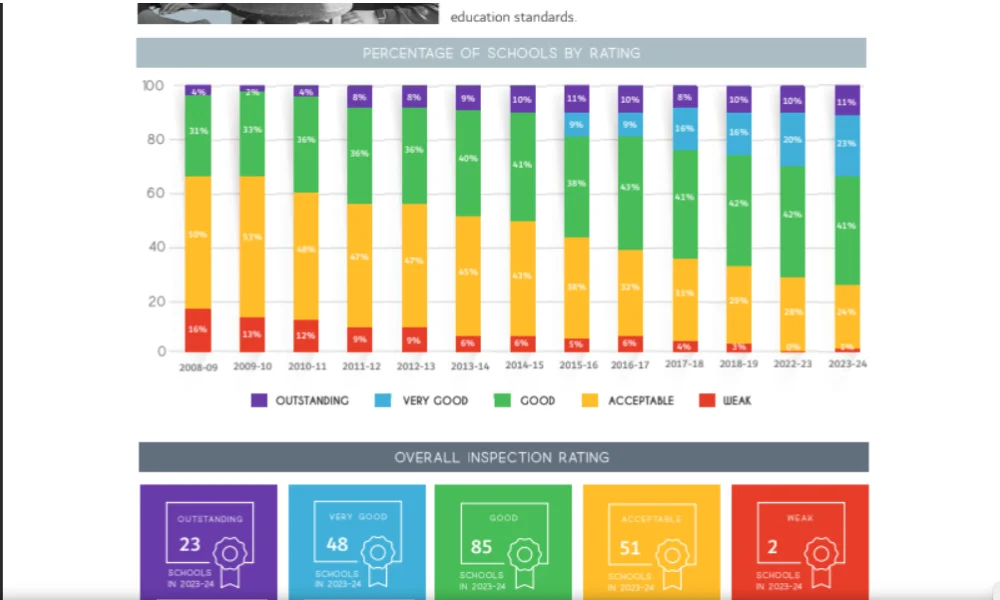
Very Weak is genuinely rare in practice. Most Dubai private schools land somewhere between Good and Outstanding, with Good and Very Good being the most common outcomes. Outstanding is a real achievement, not a marketing word, and schools generally build up to it over several inspection cycles rather than landing there on a first inspection.
One detail worth remembering: a rating describes whether a school hits a defined quality bar, not how it ranks against other schools. “Good” isn’t “below average.” It’s the expected standard for every school in Dubai.
What KHDA Actually Inspects: The Six Performance Standards
This is the part that turns a KHDA rating from a badge into something you can actually use. The overall rating is built from six performance standards, and each one is rated separately before being rolled up into the overall judgement.

1. Students’ achievement. This covers attainment (what students know and can do right now) and progress (how far they’ve come from where they started). Inspectors look at internal assessment data, external exam results, and work in students’ books, subject by subject.
2. Students’ personal and social development, and their innovation skills. How students behave, how responsible and resilient they are, how engaged they are with learning and with the wider community. This also increasingly covers innovation and entrepreneurial thinking, which has become a bigger theme in recent UAE education strategy.
3. Teaching and assessment. This is usually where inspectors spend the bulk of their time on campus. They observe lessons across year groups and subjects, and judge how well teachers plan, explain, question, differentiate for different learners, and use assessment to actually adjust teaching.
4. Curriculum. Is it broad and balanced? Is it appropriately adapted for the school’s specific student population? Does it include Arabic, Islamic Education, and UAE Social Studies as required, regardless of the school’s core curriculum?
5. The protection, care, guidance, and support of students. This covers safeguarding, health and safety, pastoral care, and how well the school identifies and supports students who need extra help, including Students of Determination.
6. Leadership and management. How well the school is actually run. Whether leadership has a clear, honest view of its own strengths and weaknesses, and whether it acts on that view.
A school cannot be rated Outstanding overall if a major standard only reaches Good. That’s a deliberate design choice, meant to stop strong exam results from masking real weaknesses elsewhere, like leadership or student wellbeing.
Wellbeing and Inclusion Get Their Own Spotlight
On top of the six core standards, KHDA reports a separate wellbeing rating and looks specifically at inclusive education and provision for Students of Determination. This has become a bigger focus in recent inspection cycles, not a side note.
In the most recent full inspection results before the pause (2023-24), a large majority of Dubai private schools scored Good or higher on both wellbeing and inclusive education, and that share has been trending upward. If you have a child with additional learning needs, this is genuinely worth reading in detail rather than skimming past, since a school’s overall rating can be strong while its inclusion provision is a separate story worth checking on its own.
Ratings Aren’t Just One Number: Phases and Subjects Matter Too
Here’s something a lot of parents miss entirely. A KHDA report doesn’t just give one overall rating. Larger schools are also rated by phase, meaning Foundation Stage (early years), Primary, and Secondary, including Post-16 where it applies.
It’s completely normal for a school to have, say, a Very Good primary section and a Good secondary section, or the reverse. If you’re enrolling a five-year-old, the primary phase rating matters far more to you right now than the secondary rating does.
Inside the full report, you’ll also find subject-level ratings, split by attainment and progress. A school that’s Outstanding overall might be noticeably weaker in Arabic or Islamic Studies than in English and Maths, or vice versa.
If your child has a particular academic strength or an area they’ll need extra support in, this is where you actually check whether a specific school delivers on that, rather than relying on the one-word summary everyone else quotes.
Common Misconceptions Parents Have About KHDA Ratings
“Outstanding automatically means it’s the best school for my child.” Outstanding measures the school’s overall performance against a national standard. It says nothing about fit, curriculum match, class size for your child’s specific needs, or whether the culture suits your family. A Very Good school with an exceptional SEN department can genuinely be the better choice for a specific child.
“Good is basically a bad rating.” No. Good is the explicit baseline every school in Dubai is expected to meet. It’s a solid, respectable outcome, not a warning sign.
“The rating changes every year, so last year’s is basically useless.” Actually the opposite problem exists right now. Because full inspections paused for two years, many schools are currently displaying a rating that’s a few years old. That’s not the school’s fault, but it does mean you should check the inspection year attached to any rating you’re looking at.
“KHDA ratings and school fees move together.” They don’t move in lockstep. KHDA’s fee framework does factor performance into how much a school is allowed to raise fees year over year, but current fee levels and current rating aren’t the same thing. You’ll find both high-fee and mid-fee schools sitting at the same rating.
“A school with a lower rating is automatically a bad choice.” A rating is one data point in a much bigger decision. A school rated Acceptable that’s actively working through a clear improvement plan, with a curriculum and community that genuinely fits your child, can still be the right call for your family. Context matters more than the single word on the badge.
How To Actually Use the Rating When Choosing a School
- Check the live, current rating on KHDA’s own site, not just what’s printed on the school’s homepage. School marketing pages don’t always get updated the moment a new report is published, and with inspections resuming unevenly across schools in 2026-27, this matters more than usual right now.
- Note the inspection date. A 2023-24 rating being displayed in 2026 isn’t dishonest, it may simply be the most recent one available. But it’s useful context, especially if you know the school went through changes in leadership or ownership since then.
- Read past the headline rating into the six standards, especially teaching and assessment, and leadership and management. These two tend to be the most predictive of day-to-day experience.
- Check the wellbeing and inclusion sections specifically if either matters for your child, rather than assuming they track the overall score.
- Look at phase-level ratings, not just the whole-school number, since that’s what actually applies to the year group your child will be in.
- Cross-reference with curriculum, fees, location, and waitlist reality. A slightly lower-rated school that’s a genuine fit on every other dimension often beats a top-rated school that’s a stretch on commute or budget.
- Visit in person where possible. A report can’t fully capture culture, and with short-notice inspections becoming the norm for KHDA itself, there’s something to be said for applying the same principle to your own school visits: ask to see an ordinary day, not a showcase one.
Where To Check a School’s Current KHDA Rating
The only fully reliable source is KHDA’s own school ratings portal at khda.gov.ae. It lists every registered private school in Dubai, along with the current rating, the year of the most recent inspection or monitoring visit, and a link to the full published report where available.
Treat third-party ranking lists and school marketing pages as a starting point, not the final word, and always verify directly before making a decision.
Frequently Asked Questions
What does KHDA Outstanding mean?
Outstanding is the highest rating on KHDA’s six-point scale. It means a school’s performance substantially exceeds UAE expectations across nearly every one of the six performance standards KHDA inspects, including teaching, leadership, student achievement, and wellbeing. It’s genuinely rare and usually reflects sustained performance across multiple inspection cycles.
Is a Good rated school still worth considering?
Yes, absolutely. Good is the explicit baseline standard every school in Dubai is expected to meet. It’s not a weak result. Most Dubai private schools sit at Good or Very Good, so a Good rating puts a school firmly in the mainstream of solid, dependable options.
How often does KHDA re-inspect schools?
Historically, schools were inspected roughly every one to two years, more frequently if performance was lower. That cycle paused for the 2024-25 and 2025-26 academic years. From 2026-27, inspections resume under a new model where KHDA decides, using its own data analysis, whether a school gets a full inspection or a shorter monitoring visit, so the frequency now varies more by school than it used to.
Do KHDA ratings affect school fees?
Indirectly, yes. KHDA’s fee framework ties the maximum permitted annual fee increase partly to a school’s performance rating, so higher-rated schools generally have more room to raise fees. But current fee level and current rating aren’t directly linked figure for figure, and you’ll find schools at the same rating charging noticeably different fees.
What’s the difference between KHDA and ADEK ratings
KHDA regulates and rates private schools in Dubai. ADEK, the Abu Dhabi Department of Education and Knowledge, does the same for Abu Dhabi, and SPEA covers Sharjah. All three now use the same UAE Unified Inspection Framework, the same six-point scale, and the same six core performance standards, so ratings are broadly comparable across emirates. One difference: KHDA reports a separate wellbeing rating that ADEK and SPEA don’t currently publish in the same way.
Can a school’s KHDA rating go down?
Yes. Ratings reflect the most recent inspection, and a school can move in either direction between cycles depending on leadership changes, staff turnover, or whether previous recommendations were acted on. This is another reason to check the inspection date rather than assuming a rating is permanent.